
A leaf blower’s CFM rating tells you how much air it moves. For most U.S. homeowners, 300 to 500 CFM is enough for a small or average yard with dry leaves. Choose 500 to 700 CFM for wet leaves, large lawns, pine needles, or heavier debris. Backpack blowers may exceed 1,000 CFM for large properties and commercial work.
CFM is only part of the answer. MPH measures air speed, while CFM measures air volume. A good blower needs enough of both to move the type of debris on your property.
Leaf Blower CFM Chart by Yard Job
The chart below gives practical airflow ranges for common U.S. yard tasks. These are buying guidelines, not an industry rating system. Actual results depend on the blower design, nozzle, battery charge, debris type, and how the manufacturer measured CFM.
| Yard task | Suggested CFM | Useful air speed | Best blower type |
|---|---|---|---|
| Small patio, porch, or driveway | 100–250 CFM | 80–120 MPH | Compact cordless or corded blower |
| Dry leaves on a small yard | 200–400 CFM | 100–150 MPH | Handheld cordless blower |
| Average suburban yard | 300–500 CFM | 120–180 MPH | Mid-range cordless or electric blower |
| Thick dry leaves | 400–600 CFM | 140–190 MPH | Powerful handheld blower |
| Wet leaves and pine needles | 500–700 CFM | 150–200 MPH | High-output handheld or backpack blower |
| Large yard with heavy leaf cover | 600–900 CFM | 160–220 MPH | High-output backpack blower |
| Commercial or very large property | 900–1,100+ CFM | 180–240+ MPH | Commercial backpack blower |
| Light snow or loose grass clippings | 300–600 CFM | 120–180 MPH | Medium or high-output blower |
How to use the chart
Start with the debris, not the largest number on a product box.
- Choose 200–400 CFM for light, dry leaves and small hard surfaces.
- Choose 300–500 CFM for routine lawn and driveway cleanup.
- Choose 500–700 CFM when leaves are wet, packed together, or mixed with pine needles.
- Choose 700 CFM or more for large properties, deep leaf piles, or long work sessions.
- Consider a backpack blower when the blower’s weight or runtime would make a handheld model tiring.
A lower-CFM blower can still work well if you clear small areas often. A high-CFM model can waste battery power and feel harder to control on a small patio.
These ranges are analysis based on common manufacturer specifications and typical yard conditions, not a formal performance standard. The U.S. Consumer Product Safety Commission and manufacturers generally direct users to follow the specific owner’s manual for operation, maintenance, and safety limits.
What Does CFM Mean on a Leaf Blower?
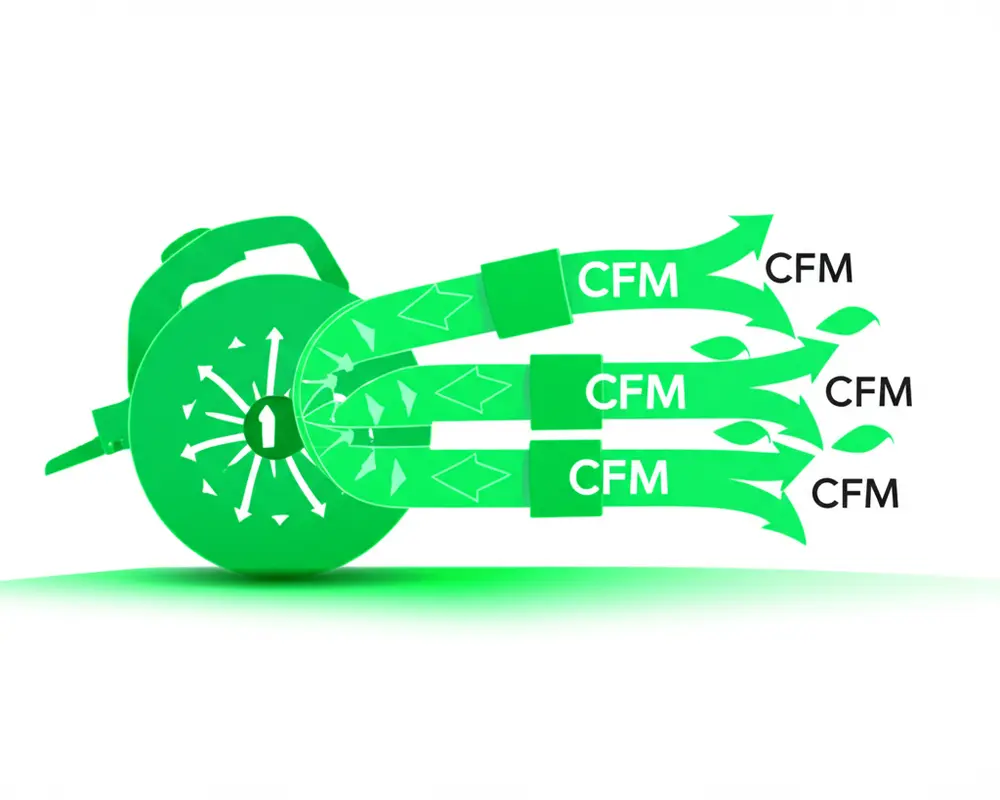
CFM means cubic feet per minute. It measures the volume of air that passes through the blower in one minute.
A blower rated at 500 CFM moves more air than one rated at 300 CFM, assuming both ratings were measured under comparable conditions. More air volume helps gather many leaves into a pile and move debris across grass.
CFM does not tell you how fast the air leaves the nozzle. That measurement is MPH, or miles per hour.
CFM versus MPH
Think of CFM as the size of the air stream and MPH as its force at the outlet:
- Higher CFM: Moves more leaves at once.
- Higher MPH: Helps loosen stuck leaves and direct a narrow stream.
- High CFM plus high MPH: Usually provides the most useful all-around performance.
- High MPH with low CFM: May move a small amount of debris quickly but struggle with broad leaf piles.
A narrow nozzle often increases the listed MPH by concentrating the air. It may not increase the blower’s total air volume.
Why CFM often matters more for leaf piles
MPH can help break a leaf away from a wet surface. CFM helps carry a large group of leaves across the lawn.
For most homeowners, the best combination is:
- Enough MPH to loosen the debris.
- Enough CFM to move the debris after it breaks free.
- A nozzle shape that gives you control.
Do not compare CFM and MPH as if they were interchangeable. They measure different things.
How Much CFM Do You Need?
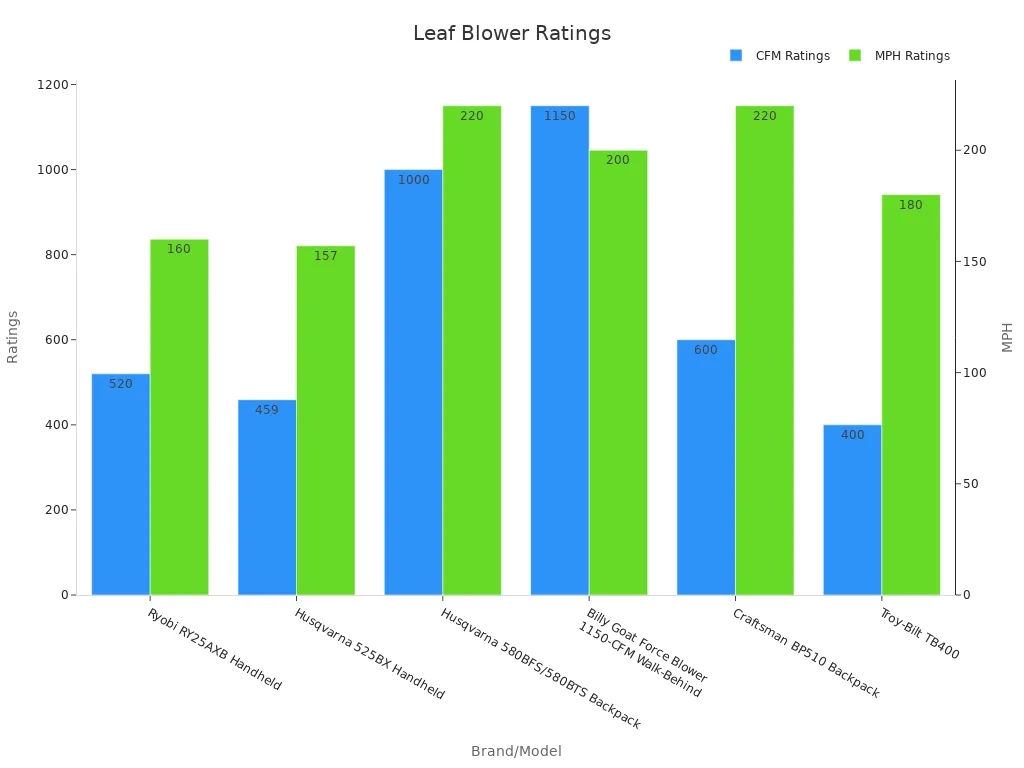
Most U.S. homeowners should look for 300 to 500 CFM for general yard work. Move toward the higher end when the yard has wet leaves, steep areas, pine needles, or frequent fall cleanup.
Small yards and hard surfaces
A blower producing 100 to 300 CFM can handle:
- Porches
- Decks
- Sidewalks
- Small driveways
- Grass clippings
- A few dry leaves
A compact blower is easier to store and may be quieter and lighter. It may struggle with wet leaves or a deep pile.
Average suburban yards
A blower in the 300 to 500 CFM range is a practical fit for many homes. It can handle dry leaves on lawns, sidewalks, and driveways without the size of a commercial backpack unit.
Look for variable-speed control. Lower speed helps with flower beds and gravel. Higher speed helps with leaf piles and lawn edges.
Wet leaves and pine needles
Wet leaves stick to grass and pavement. Pine needles can also settle into turf and cracks. For these jobs, 500 to 700 CFM is a better target.
You may still need to rake or loosen leaves by hand. No CFM rating guarantees that a blower will move soaked debris, especially when leaves have been pressed into the ground.
Large properties
Large yards often benefit from 600 to 900 CFM. A backpack blower may be more comfortable because it transfers much of the weight to your back and hips.
For commercial work or very large properties, models above 900 CFM can reduce cleanup time. They also tend to be louder, heavier, and more expensive to operate.
CFM and MPH: What Should You Prioritize?
Prioritize CFM for moving large volumes of leaves and MPH for loosening stubborn debris. If you can compare only one number, CFM is often the more useful starting point for broad lawn cleanup, but the best choice depends on the task.
| Cleanup need | More important specification |
|---|---|
| Moving a large leaf pile | CFM |
| Removing leaves from grass | CFM with adequate MPH |
| Loosening wet leaves | MPH and focused nozzle |
| Clearing a driveway | Balanced CFM and MPH |
| Removing grass from cracks | High MPH |
| Cleaning flower beds | Variable-speed control |
| Long cleanup sessions | Runtime, weight, and noise |
A simple selection rule
Use this rule when comparing models:
- Small, light debris: Focus on control and weight.
- Large piles: Focus on CFM.
- Stuck or wet debris: Check MPH and nozzle design.
- Mixed yard work: Choose a model with balanced CFM, MPH, and variable speed.
Manufacturers do not always test CFM and MPH in the same way. Some list maximum values at the housing. Others list values at the nozzle. This makes direct comparisons less reliable than the numbers suggest.
How Manufacturers Measure Leaf Blower CFM
A product’s CFM rating is useful only when you understand the test point and conditions.
Manufacturers may list:
- Maximum CFM: The highest airflow under a stated test condition.
- Rated CFM: A value measured at a specified point or operating mode.
- CFM at the nozzle: Airflow measured at the outlet.
- CFM at the housing: Airflow measured closer to the blower body.
- Tube or nozzle CFM: Airflow measured with a particular attachment.
A blower can have a higher housing CFM but a lower nozzle CFM than another model. The nozzle, tube length, battery state, filter condition, and test method can all change the result.
How to compare specifications fairly
When shopping, check the following:
- Use the same measurement point. Compare nozzle CFM with nozzle CFM when possible.
- Check whether the value is maximum or operating output.
- Look for the nozzle or tube used during testing.
- Compare battery models with the battery installed and fully charged when the manufacturer provides that information.
- Read the owner’s manual for runtime and operating limits.
If a product page lists only one impressive number, treat it as a starting point rather than a complete performance test. A higher advertised CFM does not always mean faster real-world cleanup.
Battery, Corded, Gas, or Backpack: Does Power Source Change CFM?
The power source affects airflow, runtime, weight, noise, and maintenance. It does not create a separate definition of CFM.
Cordless battery blowers
Cordless models are convenient for most residential yards. Their output may drop as the battery charge falls, and high-speed use can shorten runtime.
Check:
- Battery voltage and capacity
- Claimed runtime at each speed
- Whether the battery and charger are included
- Weight with the battery attached
- Availability and cost of replacement batteries
Voltage alone does not prove higher airflow. Motor design, fan design, controls, and nozzle shape also matter.
Corded electric blowers
Corded models can provide steady power for small areas near an outlet. Their main limits are the cord, outdoor outlet access, and the need to use a properly rated outdoor extension cord.
Follow the owner’s manual and the extension-cord instructions. Keep the cord away from water, heat, sharp edges, and the blower’s air path.
Gas handheld blowers
Gas models can offer long operating periods with refueling and may suit larger properties. They require fuel, engine maintenance, and correct storage. Exhaust and noise are also concerns.
State and local rules may limit the use of gas-powered leaf blowers. Check local requirements in your city or county before buying or operating one.
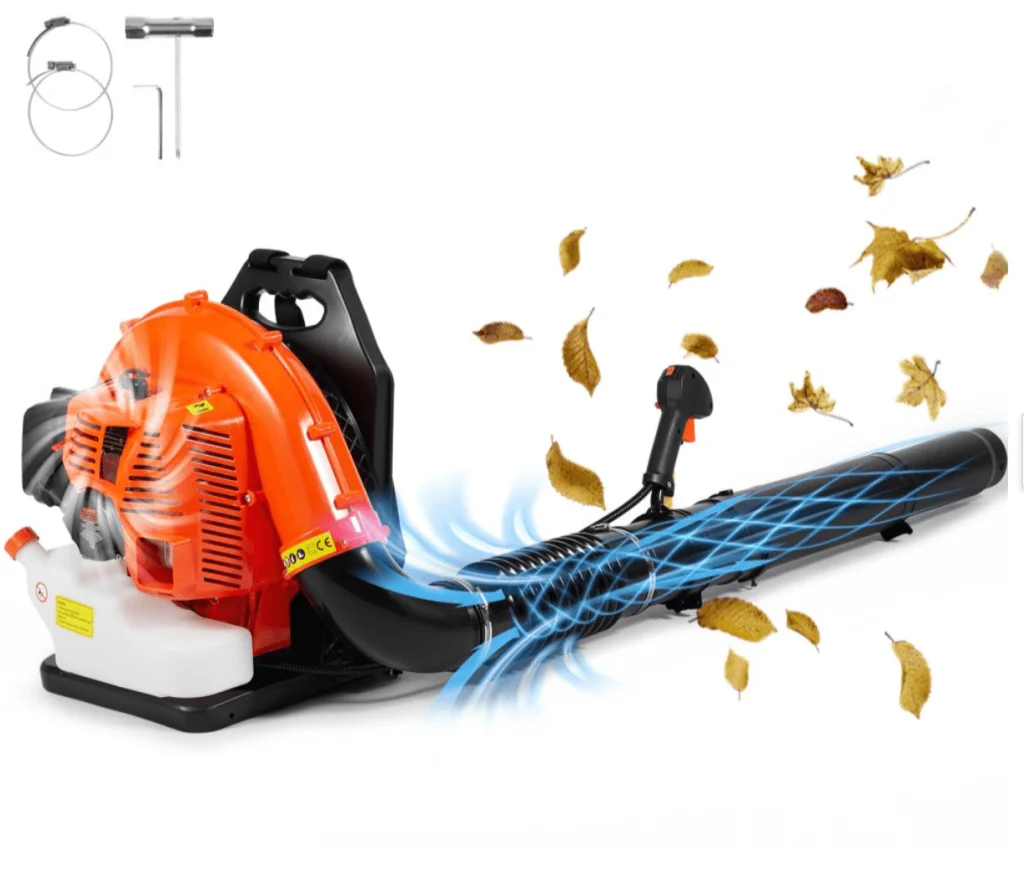
Backpack blowers
Backpack blowers make sense when airflow, runtime, or comfort matters more than compact size. They are often better for large properties, but they can be louder and more powerful than needed for a small yard.
How to Read a Leaf Blower Specification Sheet
Use the specification sheet as a comparison tool, not as a promise of identical field performance.
Look for these values:
Maximum air speed
This is usually shown in MPH. It may be measured with a narrow nozzle. It tells you about the speed of the air stream, not the total amount of air moved.
Maximum air volume
This is usually shown in CFM. Confirm whether it is measured at the nozzle or blower housing.
Noise rating
Noise may be listed in decibels, often as dB(A). The test distance and method matter. A small change in the number can represent a meaningful change in sound exposure, so use hearing protection and keep distance from other people.
The CDC and National Institute for Occupational Safety and Health recommend reducing exposure to loud equipment and using hearing protection when needed. Follow the equipment manual and local noise rules.
Runtime
Battery runtime depends on speed, battery size, temperature, debris, and how often you stop. A listed “up to” runtime usually reflects a lower-power setting or controlled test.
Weight
Check whether the listed weight includes the battery, fuel, or tube. A blower that looks light on paper can feel tiring after repeated use.

A Simple Way to Choose the Right CFM
Use this four-step method before buying.
Step 1: Identify the debris
Dry leaves need less force than wet leaves. Pine needles, acorns, small twigs, and packed grass may need more focused airflow.
Step 2: Measure the work area
A small patio does not need the same blower as a half-acre lot. Larger areas increase the value of higher CFM, longer runtime, and a comfortable harness.
Step 3: Choose a CFM range
Use the chart as a starting point:
- 100–300 CFM: Small surfaces and light cleanup
- 300–500 CFM: Most routine residential work
- 500–700 CFM: Wet leaves and difficult debris
- 700–900 CFM: Large yards and heavy leaf cover
- 900+ CFM: Commercial or very large-property use
Step 4: Check the features that affect control
A variable-speed trigger, cruise control, shoulder strap, swappable battery, and included nozzles may matter more than an extra 50 CFM.
The correct blower is the one that moves your debris without creating unnecessary noise, fatigue, or loss of control.
Common Leaf Blower CFM Mistakes
Several buying mistakes can make a powerful blower feel disappointing.
Mistake 1: Choosing by MPH alone
A high MPH number may come from a narrow nozzle. The blower may still move too little air for a large leaf pile.
Mistake 2: Choosing by CFM alone
Very high CFM can be hard to control around mulch, gravel, flower beds, and loose soil. The blower may also be heavier and louder.
Mistake 3: Comparing different test methods
A nozzle CFM and housing CFM are not equal comparison points. Check the specification details before ranking models.
Mistake 4: Ignoring wet debris
Wet leaves can require much more effort than dry leaves. If wet fall cleanup is common in your area, choose a stronger model and use a rake when leaves are stuck to the ground.
Mistake 5: Forgetting runtime
A high-output cordless blower may drain its battery quickly at full speed. Check whether the package includes a battery and how long it runs at the setting you plan to use.
Mistake 6: Using maximum power everywhere
Maximum power can scatter leaves instead of forming a pile. Start at a low setting, aim the nozzle at a shallow angle, and increase power only when needed.
Leaf Blower Safety and Local Rules
Use a leaf blower only when you can control the air stream and keep people, pets, and property clear.
Follow these basic precautions:
- Wear eye protection.
- Use hearing protection around loud blowers.
- Wear sturdy shoes with good traction.
- Keep children and pets away from the work area.
- Do not point the blower at people, animals, vehicles, or windows.
- Check the area for rocks, sticks, and other objects before starting.
- Avoid blowing dust, mold, animal waste, or other potentially harmful material toward yourself or others.
- Never modify a guard, tube, switch, or safety feature.
- Stop the blower before clearing a blockage or changing an attachment.
- Read the product manual before use.
Do not blow leaves into streets, storm drains, neighboring property, or waterways. Many U.S. cities and counties have rules for leaf-blower hours, noise, emissions, and seasonal use. Check your local government website because these rules vary by location and can change.
For large commercial operations, employers may have additional obligations for noise, protective equipment, and training under Occupational Safety and Health Administration requirements.
Key Takeaways
- 300–500 CFM suits many average U.S. residential yards.
- Use 200–400 CFM for small areas and dry leaves.
- Choose 500–700 CFM for wet leaves, pine needles, and heavier debris.
- Use 700–900+ CFM for large properties or deep leaf cover.
- CFM measures air volume; MPH measures air speed.
- Compare CFM values only when the test point and conditions are similar.
- Variable speed, runtime, weight, noise, and local rules can matter as much as airflow.
- Start at low power and increase speed as needed for better control.
Frequently Asked Questions
Is 300 CFM enough for a leaf blower?
Yes, 300 CFM is often enough for dry leaves on a small or average residential property. It may struggle with wet leaves, deep piles, pine needles, and debris pressed into grass.
Is higher CFM always better?
No. Higher CFM moves more air, but it can be harder to control and may scatter mulch, gravel, or soil. It can also increase weight, noise, cost, and battery use.
Is 400 CFM good for a leaf blower?
Yes. A 400-CFM blower is a useful middle range for many homeowners. It can handle routine dry-leaf cleanup, grass clippings, driveways, sidewalks, and patios.
What is more important, CFM or MPH?
Neither number works alone. CFM helps move a large volume of leaves, while MPH helps loosen stubborn debris. For general yard cleanup, look for a balanced combination with variable-speed control.
How much CFM do I need for wet leaves?
Plan on about 500–700 CFM for wet leaves, but conditions matter. Leaves stuck to wet grass may still need a rake or other manual tool.
Can a leaf blower move small twigs?
A powerful blower may move light twigs, but airflow is not a substitute for picking up large branches or hard objects. Remove large debris before blowing and wear eye protection.
Why does my blower not seem as powerful as its CFM rating?
Check the battery charge, air intake, tube, nozzle, filter, and any blockage. Also confirm whether the advertised CFM was measured at the housing or nozzle. A partially charged battery or clogged intake can reduce output.

Conclusion
The best leaf blower CFM depends on your yard, debris, and work habits. For most U.S. homeowners, a model in the 300–500 CFM range offers a practical balance of power and control. Move to 500–700 CFM for wet leaves and difficult fall cleanup, or choose 700 CFM and above for large properties and heavy debris.
Use CFM as the starting point. Then compare MPH, nozzle design, runtime, weight, noise, and local operating rules. Before buying, check the manufacturer’s measurement method and select the lowest airflow that can complete your normal work without excessive strain or loss of control.