
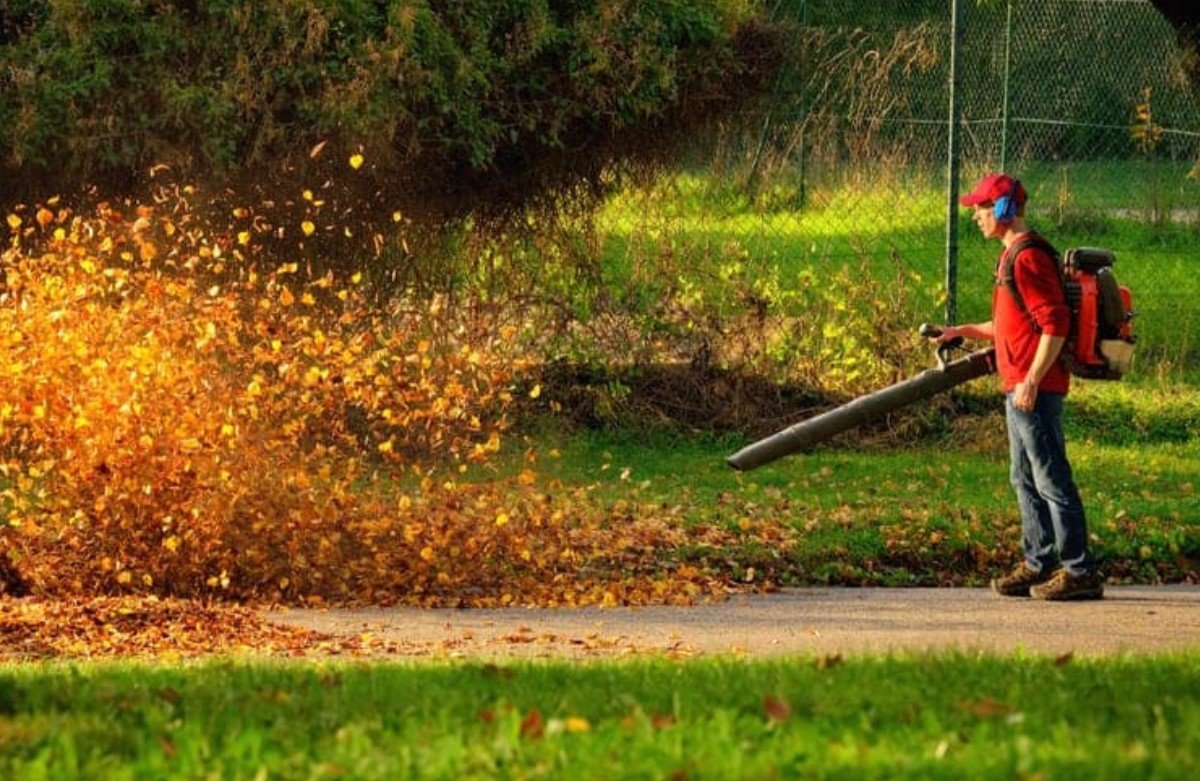
Across the United States, a leaf blower usually produces about 60 to 90 decibels (dB), depending on its power source, design, speed, and measuring distance.
- Battery and corded electric models: often about 60–75 dBA
- Gas handheld models: often about 70–90 dBA
- Gas backpack models: often about 75–95 dBA
- Quiet-rated electric models: sometimes measure near 60–65 dBA
A leaf blower’s sound rating can change greatly with distance. A number measured at the operator’s ear will be much higher than one measured 50 feet away. Always check the product manual for the exact test method before comparing models.

What Does a Leaf Blower’s Decibel Rating Mean?
A decibel rating measures sound pressure. Leaf blower labels usually use A-weighted decibels, written as dBA. This scale reflects the way human hearing responds to different pitches.
The dBA number is not a simple percentage. Decibels use a logarithmic scale:
- A 3 dB increase represents about twice the sound energy.
- A 10 dB increase is often heard as roughly twice as loud.
- A 20 dB increase is often heard as about four times as loud.
For example, a 90 dBA blower is not just slightly louder than a 70 dBA blower. It produces far more sound energy and may feel much louder to the person nearby.
Why the distance matters
Sound spreads as it moves away from the blower. In open space, moving twice as far from a sound source can reduce the level by about 6 dB, although walls, trees, pavement, wind, and other surfaces can change the result.
A blower rated at 90 dBA near the operator may measure much lower at a property line. That does not mean the machine is quiet for the person holding it.
Typical Leaf Blower Noise Levels
The table below gives general ranges. These are not fixed limits for every model.
| Leaf blower type | Typical sound range | Common measuring condition |
|---|---|---|
| Low-noise battery blower | 60–68 dBA | Manufacturer test, often at a set distance |
| Standard battery blower | 65–75 dBA | Varies by speed and distance |
| Corded electric blower | 65–80 dBA | Varies by motor and nozzle |
| Gas handheld blower | 70–90 dBA | Often loudest near the operator |
| Gas backpack blower | 75–95 dBA | High power can increase sound |
| Turbo or maximum-speed setting | 3–10 dB higher than low speed | Depends on model |
Some product pages list sound pressure at the operator’s ear. Others list sound power, which is a different measurement. A sound-power value can appear higher because it describes the total acoustic output of the machine rather than the sound at one location.

How Loud Is a Battery Leaf Blower?
Most battery leaf blowers produce about 60 to 75 dBA, but high-output models can be louder. The actual level depends on the motor, fan, battery voltage, air speed, air volume, and selected operating mode.
A battery blower may be quieter than a gas model because it has no combustion engine or exhaust system. It can still create substantial noise from the fan and fast-moving air.
Many battery models have several settings:
- Low mode: useful near flower beds and light debris
- Medium mode: suitable for dry leaves on lawns and driveways
- Turbo mode: useful for wet leaves but usually much louder
If reducing noise matters, use the lowest setting that moves the debris. This can also extend battery life and reduce dust.
How Loud Is a Gas Leaf Blower?
A gas leaf blower commonly produces about 70 to 90 dBA, with some powerful backpack models reaching higher levels near the operator.
Gas blowers tend to be loud because they combine several sources of sound:
- Engine combustion
- Exhaust noise
- Cooling fan noise
- Air movement through the tube
- Vibration from the engine and housing
A gas blower’s sound may also seem harsher than an electric blower because engine noise contains strong low- and mid-frequency tones. Two machines with similar dBA readings may not sound equally unpleasant.
Gas blowers may also create more vibration and exhaust exposure. Follow the manufacturer’s instructions, never use a gas blower indoors, and keep fuel away from ignition sources.

Is a Leaf Blower Loud Enough to Damage Hearing?
Yes. A leaf blower can be loud enough to contribute to hearing damage, especially when used close to the head for long periods.
The National Institute for Occupational Safety and Health, or NIOSH, uses 85 dBA over an eight-hour workday as a recommended exposure limit. The time limit becomes shorter as sound levels rise. NIOSH applies a 3 dB exchange rate, meaning that each 3 dB increase cuts the recommended exposure time in half.
A simplified NIOSH exposure guide looks like this:
| Sound level | Approximate recommended exposure time |
|---|---|
| 85 dBA | 8 hours |
| 88 dBA | 4 hours |
| 91 dBA | 2 hours |
| 94 dBA | 1 hour |
| 97 dBA | 30 minutes |
| 100 dBA | 15 minutes |
These values are for occupational noise exposure and are not a personal diagnosis. They show why a loud blower deserves hearing protection, even when it is used only for yard work.
The Occupational Safety and Health Administration, or OSHA, also regulates workplace noise exposure. Its rules differ from the NIOSH recommendation, so employers should follow the requirements that apply to their workplace.
Should You Wear Hearing Protection With a Leaf Blower?
Wear hearing protection when the blower sounds loud, when you use it for more than a short period, or when you cannot confirm its sound level.
Useful options include:
- Foam earplugs: light and inexpensive when fitted correctly
- Reusable earplugs: washable and convenient
- Earmuffs: easy to put on and useful for short tasks
- Dual protection: earplugs plus earmuffs for very loud equipment or long use
Hearing protection works only when it fits well. Foam earplugs must be rolled, inserted deeply enough, and held in place while they expand. Earmuff cushions should seal around the ears without gaps.
Do not use hearing protection as a reason to ignore other hazards. You still need eye protection, stable footing, and awareness of vehicles, people, pets, and nearby equipment.
How to Check Your Leaf Blower’s Actual Decibel Level
The most reliable way to compare your blower with another machine is to measure both under the same conditions.
1. Check the manual first
Look for terms such as:
- Sound pressure level
- Sound power level
- dBA at the operator’s ear
- dBA at 50 feet
- Guaranteed sound power level
- Noise emission value
Write down the distance, operating mode, and test standard. A rating without those details is difficult to compare.
2. Use a quality sound level meter
A dedicated sound level meter is better than a phone microphone for accurate measurements. Phone apps can show rough differences, but they may not measure low and high frequencies correctly.
If using a meter:
- Select A-weighting, shown as dBA or dB(A).
- Set the blower to the speed you want to compare.
- Measure at a fixed distance, such as 3 feet or 50 feet.
- Keep the meter away from walls and large reflective surfaces.
- Take several readings and record the average or highest stable reading.
- Test each blower under the same weather and surface conditions.
Never hold the meter directly in the air stream. The moving air can create errors and may damage some microphones.
3. Measure from the operator’s position
For hearing safety, measure near the operator’s ear position rather than only at the property line. Keep the meter away from the body and do not place it inside the ear.
A property-line reading helps with neighborhood noise. An operator-position reading helps with hearing protection. They answer different questions.

What Makes a Leaf Blower Louder?
The blower’s design matters, but operating conditions also change the sound level.
Engine or motor power
More power can produce more air movement and more noise. A large motor does not always mean a louder machine, because fan design and housing can improve efficiency.
Fan speed
Noise usually rises when the fan spins faster. Turbo mode often creates a noticeable increase in sound compared with low mode.
Nozzle design
A narrow nozzle can increase air speed and create a sharper rushing sound. A wider nozzle may move more air with a lower-pitched sound, although the measured dBA level still depends on the model.
Material and surface
Dry leaves on grass may sound quieter than leaves blown across concrete. Hard surfaces reflect sound and can make the blower seem louder.
Distance and direction
The blower may sound louder when the nozzle points toward a wall, fence, vehicle, or building. These surfaces reflect sound back toward the operator and neighbors.
Maintenance
A damaged fan, loose cover, clogged intake, worn bearing, or poorly fitted tube can increase noise and vibration. Shut off the blower before inspecting it, disconnect the battery or spark plug where applicable, and follow the service instructions.
How to Choose a Quieter Leaf Blower
Choose a blower by its documented dBA rating, not only by its motor type or marketing language.
Use this process:
- Find the sound rating. Look in the manual, not only on a store listing.
- Confirm the measurement method. Check whether it is sound pressure or sound power.
- Compare the same distance. A 50-foot reading should not be compared directly with an operator-ear reading.
- Check the operating mode. Ask whether the rating applies to low, normal, or turbo speed.
- Consider the job. A smaller blower may be enough for a patio, while a large yard may require more air volume.
- Use a lower setting when possible. Less speed usually means less noise.
- Check local rules. U.S. cities, counties, homeowners associations, and state agencies may set different time or noise limits.
A quieter blower may move leaves more slowly. That trade-off can be worthwhile near homes, schools, hospitals, parks, and dense neighborhoods.
Leaf Blower Noise and Local U.S. Rules
Noise rules vary across the United States. Some local governments regulate leaf blowers by:
- Time of day
- Maximum sound level
- Distance from homes or property lines
- Engine type
- Season
- Residential or commercial use
- Exhaust emissions
A blower that is legal in one city may be restricted in another. Rules may also change over time. Check the official website for your city, county, or state before buying equipment for regular commercial or residential work.
Do not assume that a manufacturer’s dBA rating proves legal compliance. Local rules may use a different measurement distance, test method, or limit.

Common Mistakes When Comparing Leaf Blower Noise
Comparing different measuring distances
A reading taken at the operator’s ear cannot be compared directly with one taken 50 feet away. Always match the distance and test method.
Treating dB as a linear scale
An increase from 70 to 80 dBA is not a small 10-point change. It represents a much larger increase in sound energy.
Trusting a phone app as a certified measurement
Phone apps can help identify a loud setting or compare two machines. They are not a substitute for a calibrated sound level meter when legal compliance or workplace exposure matters.
Ignoring turbo mode
A blower can be fairly quiet on low speed but much louder at full power. Compare the setting you will actually use.
Measuring beside a wall
Reflections can increase the reading. Test in an open area when possible, and keep the conditions consistent.
Assuming electric always means silent
Electric blowers usually avoid engine noise, but the fan can still produce harmful or annoying sound. Hearing protection may still be appropriate.
Frequently Asked Questions
Is 70 dB loud for a leaf blower?
A 70 dBA leaf blower is relatively quiet compared with many gas models, but it is still clearly audible. Whether it is acceptable depends on distance, use time, local rules, and nearby residents.
Is 80 dB safe for a leaf blower?
An 80 dBA blower is below the NIOSH 85 dBA recommended limit for an eight-hour workday, but long or repeated exposure can still be tiring. Wear hearing protection if you use it often or at close range.
Are electric leaf blowers quieter than gas models?
Often, yes. Battery and corded electric blowers commonly produce less sound than gas blowers, but some high-power electric models can still be loud. Compare the documented dBA rating under the same test conditions.
How far away can a leaf blower be heard?
There is no single distance. Wind, buildings, trees, traffic, terrain, and background noise all affect how far the sound travels. A blower can remain noticeable well beyond a property line, even when the measured level drops with distance.
Can a leaf blower damage a dog’s hearing?
A loud blower may distress or harm a dog, especially when used close to its ears. Keep pets indoors or far away while operating the machine. Never point the nozzle toward an animal.
Key Takeaways
- Most leaf blowers produce about 60–90 dBA.
- Battery models are often quieter than gas models, but not always.
- A blower’s rating is meaningful only when you know the distance, mode, and measurement type.
- NIOSH identifies 85 dBA over eight hours as a recommended occupational exposure limit.
- Wear hearing protection for loud or extended use.
- Check local U.S. noise rules before operating a blower near homes or businesses.
- Choose the lowest power setting that completes the job.
Conclusion
A leaf blower is commonly about as loud as a busy road or a small engine, with typical readings from 60 to 90 dBA. Low-noise electric models may be suitable for noise-sensitive areas, while gas and high-output backpack blowers can require hearing protection and more careful scheduling.
For the most useful comparison, check each model’s official dBA rating, match the measurement conditions, and consider how close the blower will be to the operator, neighbors, and pets.