
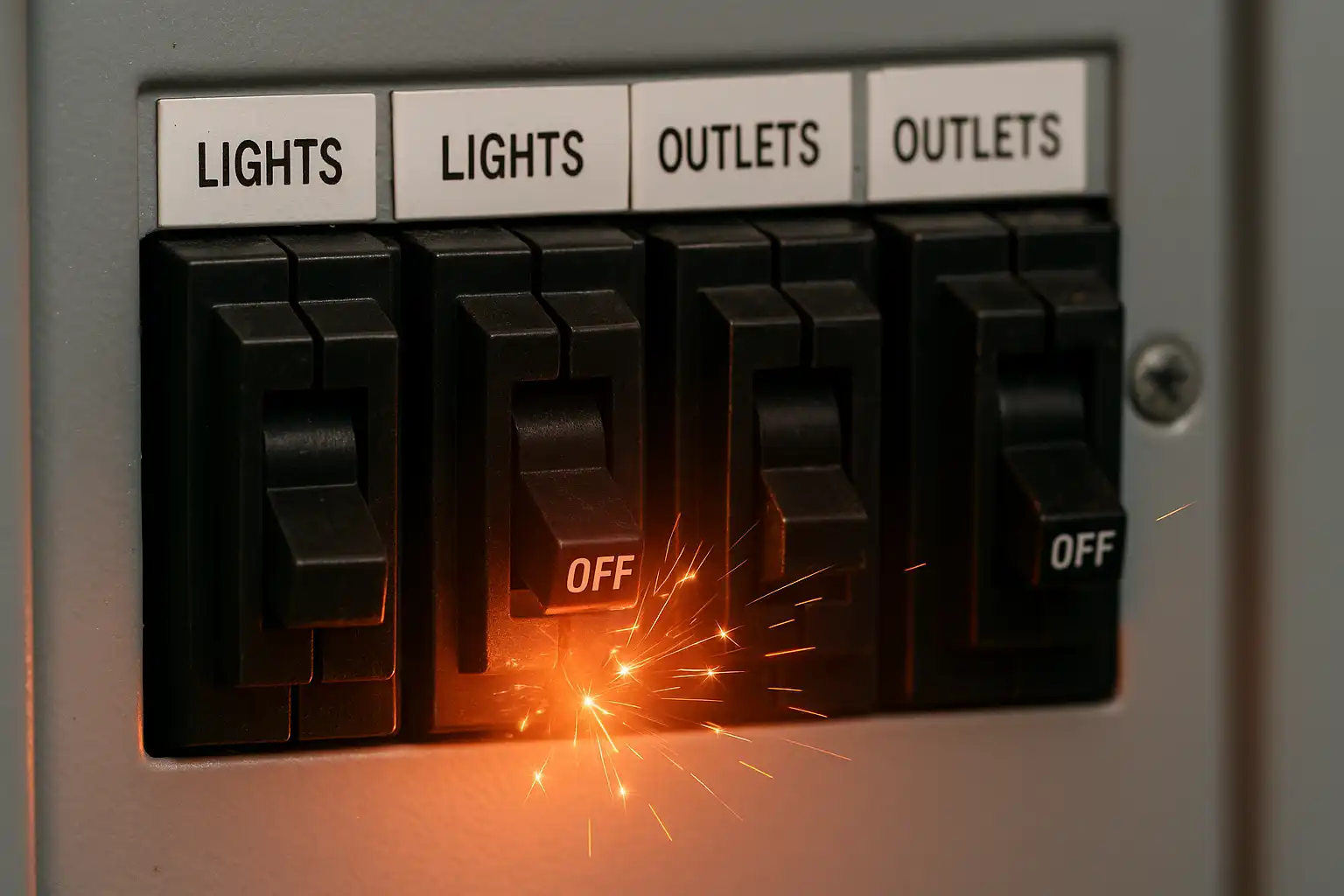
A leaf blower usually trips a circuit breaker because it draws too much current, has a damaged cord or motor, or shares a circuit with other high-power tools. A ground-fault or arc-fault device may also shut off power when it detects leakage or an unsafe electrical path.
In the United States, most corded leaf blowers use a standard 120-volt outlet. The breaker protects the branch circuit, wiring, and outlet from overheating. Do not keep resetting the breaker until it stays on. First find out whether the problem comes from the leaf blower, the extension cord, the outlet, or the home’s electrical circuit.

The Most Common Reasons a Leaf Blower Trips the Breaker
The fastest way to diagnose the problem is to note when the breaker trips. Does it trip as soon as you pull the trigger? Does it run for several minutes first? Does it trip only when other tools are running?
Each pattern points to a different cause.
1. The circuit is overloaded
A leaf blower may use much of the available capacity on a 15-amp or 20-amp household circuit. Other loads can push the total current past the breaker’s limit.
Common loads on the same circuit include:
- A shop vacuum
- A lawn mower charger
- A refrigerator or freezer
- A garage door opener
- Work lights
- A power washer
- A space heater
- Another yard tool
- Battery chargers
For a simple estimate, use this formula:
Watts ÷ volts = amps
For example, a hypothetical 1,500-watt tool on a 120-volt circuit would draw about 12.5 amps:
1,500 ÷ 120 = 12.5 amps
That leaves little room on a 15-amp circuit for other equipment. The wattage or amperage rating printed on the leaf blower label or in its manual is the correct value to use.
2. The motor has a high starting current
An electric motor can draw more current when it starts than it uses while running. This brief surge is often called starting current or inrush current.
A healthy circuit can usually handle that short surge. However, the breaker may trip if:
- The circuit is already heavily loaded.
- The extension cord is too long or too small.
- The motor is worn or damaged.
- The blower fan is blocked.
- The breaker is weak or faulty.
- The blower starts under unusual mechanical strain.
If the breaker trips the moment the motor starts, suspect a starting-current problem, a short circuit, or a motor fault.
3. The extension cord is too long or too light
A leaf blower needs an extension cord rated for outdoor use and for the tool’s current. A cord with conductors that are too small can cause voltage drop and heat.
The cord’s gauge number matters. A lower American Wire Gauge, or AWG, number means thicker conductors. The correct size depends on:
- The blower’s amperage
- The cord length
- The manufacturer’s instructions
- The cord’s outdoor rating
- The condition of the cord
Do not use a household indoor cord outdoors. Look for a cord marked for outdoor use, often with a “W” in its rating. The cord should have intact insulation, a sound plug, and a grounding prong if the blower requires one.
A long, undersized cord may not always trip the breaker by itself. It can create voltage loss, make the motor run hot, and increase the chance of a fault.
4. The blower has a short circuit
A short circuit occurs when electrical current finds an unintended low-resistance path. A breaker may trip instantly to protect the wiring.
Possible sources include:
- Crushed or cut cord insulation
- A damaged plug
- Moisture inside the blower
- Loose internal wiring
- A failed switch
- A damaged motor winding
- Debris that contacts electrical parts
A breaker that trips immediately when you plug in the blower, even before you start it, strongly suggests a cord, plug, outlet, or internal wiring problem.
Do not open the blower unless you are qualified to repair electrical equipment and the warranty and safety instructions permit it.
5. The motor is overheating
A leaf blower motor can overheat when airflow is blocked or the motor is failing. Common causes include:
- Leaves or debris blocking the intake
- A clogged air passage
- A damaged fan
- Worn bearings
- A failing capacitor, where the design uses one
- Repeated operation in extreme heat
- A motor winding problem
Some blowers have thermal protection. The tool may shut down, cool, and then work again. That does not prove the blower is safe. Repeated overheating can damage the motor and may point to a fault that needs service.
Unplug the blower before removing debris. Never put your hand into the intake or fan housing while the tool is connected to power.
6. The outlet uses GFCI protection
Outdoor receptacles in the United States commonly use ground-fault circuit-interrupter, or GFCI, protection. A GFCI is different from a standard circuit breaker.
A standard breaker mainly responds to excessive current. A GFCI responds to a small difference between the current leaving the circuit and the current returning through it. That difference can mean electricity is flowing through an unintended path, including a person or wet surface.
A GFCI may trip because of:
- Rain or water in the plug
- A wet outlet cover
- Moisture in the blower
- A damaged extension cord
- Leakage inside the motor
- Several small leakage paths combined
If the device that trips has a TEST and RESET button, it is likely a GFCI receptacle, portable GFCI, or GFCI breaker. Treat the trip as a safety warning, not as a nuisance.
7. The circuit has AFCI protection
Some homes use arc-fault circuit-interrupter, or AFCI, protection. An AFCI is designed to detect electrical arcing patterns that could start a fire.
An AFCI may trip because of:
- Damaged cord insulation
- Loose electrical connections
- A failing switch
- Motor brush or commutator problems
- A fault in the blower or extension cord
- Compatibility issues between some electronic devices and protective devices
Do not bypass an AFCI or replace it with a standard breaker. If the blower trips the AFCI repeatedly while other tools work normally, stop using the blower and have the equipment and circuit checked.

How to Find the Fault Safely
Use this sequence to separate a simple overload from a defective leaf blower. Stop at any point where you see melting, smoke, scorching, exposed wire, a damaged plug, or a burning smell.
Step 1: Unplug the blower and inspect it
Disconnect the blower from the outlet before touching the cord or housing.
Check for:
- Cuts, cracks, or flat spots in the cord
- Bent or loose plug blades
- A missing grounding prong
- Melted plastic
- Dark marks near the plug
- Water inside the plug or tool
- A blocked air intake
- A damaged fan or tube
- A burning odor
Do not use electrical tape as a permanent repair for a damaged power cord. Replace the cord or have the tool serviced by a qualified repair provider.
Step 2: Reset the protective device once
Move the breaker fully to the OFF position, then back to ON. If a GFCI outlet trips, press RESET only after the outlet and plug are dry and free of visible damage.
If the breaker will not reset with the blower unplugged, the problem may be in the circuit, outlet, wiring, or protective device. Leave it off and contact a qualified electrician.
Step 3: Remove other loads from the circuit
Unplug other tools and appliances that may share the circuit. Then try the blower only if:
- The blower and cord passed inspection.
- The outlet is dry.
- The protective device resets normally.
- No smoke, heat, or damage is present.
- The manufacturer allows use with an extension cord.
If the blower now works, the circuit was likely overloaded. Move other equipment to a separate circuit rather than repeatedly resetting the breaker.
Step 4: Check the extension cord
Use the shortest suitable outdoor-rated cord. Compare the cord requirements in the blower manual with the cord’s rating.
Replace the cord if it is:
- Warm or hot during use
- Cracked or cut
- Frayed
- Improperly repaired
- Missing its ground pin
- Too light for the blower and distance
Do not coil a long extension cord tightly while using a high-current tool. Heat can build up in the cord. Lay it out so it can release heat, while keeping it away from water, traffic, sharp edges, and the blower’s air path.
Step 5: Test the blower on a known-good circuit
If the blower and cord look safe, try the blower on a different circuit that can support its rated load. Do not use an indoor outlet for an outdoor operation unless the location and equipment are suitable and the manufacturer’s instructions allow it.
Interpret the result carefully:
| Test result | Most likely direction |
|---|---|
| Breaker trips with other tools but not the blower alone | Circuit overload |
| Blower trips several different circuits | Blower or cord fault |
| GFCI trips only outdoors or in damp conditions | Moisture or leakage |
| Breaker trips as soon as the blower starts | Short, motor fault, or high starting current |
| Blower runs, then trips after several minutes | Overheating, overload, or weak protection |
| Breaker will not reset with everything unplugged | House circuit or protective-device problem |
This test does not prove that a circuit is safe or that the blower is fault-free. It only helps narrow the cause.
Step 6: Stop using the blower if the fault follows the tool
If the blower trips more than one known-good circuit, unplug it and arrange repair or replacement. Do not continue testing it by moving from outlet to outlet.
A qualified technician can inspect the cord, switch, motor, wiring, and insulation. An electrician can inspect the outlet, circuit wiring, breaker, GFCI, or AFCI.

What the Breaker Type Tells You
The device that trips provides useful evidence.
Standard circuit breaker
A standard breaker usually trips because of:
- Too much total current
- A short circuit
- A failing breaker
- A wiring problem
A delayed trip often points to an overload or overheating condition. An instant trip is more consistent with a short or very high starting current, although the exact cause requires testing.
GFCI receptacle or breaker
A GFCI trip points to current leakage or an imbalance. Water and damaged insulation are common causes when using power tools outdoors.
Never defeat GFCI protection. Do not use a three-to-two-prong adapter to remove the grounding path. If a GFCI will not reset, leave the circuit off until the cause is found.
AFCI breaker
An AFCI trip may indicate arcing or a fault in the cord, blower, or circuit. Repeated trips deserve inspection, even if the blower still appears to run normally.
If only one tool trips an AFCI, the tool or cord is a reasonable first suspect. If many devices trip the same AFCI, the circuit or breaker may need professional diagnosis.

How to Prevent a Leaf Blower From Tripping the Breaker
Prevention starts with matching the tool, cord, outlet, and circuit.
- Read the blower’s owner’s manual before choosing an extension cord.
- Use a listed, outdoor-rated cord with the correct wire size and length.
- Keep the plug and connection off wet ground.
- Use an outdoor GFCI-protected outlet.
- Inspect the cord before every use.
- Clear the intake and air passages.
- Do not run other high-load tools on the same circuit.
- Unplug the blower before clearing jams or debris.
- Store the blower in a dry place.
- Do not use a damaged plug, cord, or housing.
- Do not replace a breaker with one rated for more current.
- Do not use a larger breaker to stop nuisance trips.
A larger breaker is not a safe fix if the circuit wiring was designed for a smaller rating. The breaker and conductor size must match the electrical system and applicable code requirements.
The U.S. Consumer Product Safety Commission provides general electrical safety information, and OSHA provides guidance on safe use of portable electric equipment and extension cords. Follow the blower manufacturer’s manual and local electrical requirements as the controlling instructions for the specific tool and installation.
When You Should Call an Electrician or Repair Technician
Call a qualified electrician when the breaker trips with the blower unplugged, the outlet is hot or scorched, or several outlets lose power. Professional help is also appropriate when the breaker will not reset, the circuit wiring is old or damaged, or you are unsure which circuit serves the outlet.
Take the blower to a qualified repair provider when it trips multiple circuits, smells burnt, sparks, gets unusually hot, or has a damaged cord or plug. Do not keep using a tool that trips protection repeatedly.
Seek urgent help if you see smoke, active sparking, melted wiring, or signs of fire. Turn off power only if you can do so safely, keep away from the equipment, and contact emergency services when there is an immediate fire risk.

Can a Bigger Breaker Fix the Problem?
No. Installing a larger breaker can allow unsafe current through wiring that was not designed to carry it. The wire may overheat before the breaker trips.
A breaker trip is useful information. It may show an overloaded circuit, a defective tool, damaged insulation, moisture, or a protective device doing its job. The safe solution is to find and correct the cause, not to defeat the protection.
Can I Use a Leaf Blower With an Extension Cord?
Usually, a corded leaf blower can be used with an extension cord when the cord meets the manufacturer’s requirements. The cord must be outdoor-rated, grounded when required, long enough without excess length, and sized for the blower’s current.
Check the manual first. If the manual prohibits an extension cord or sets a specific maximum length and gauge, follow that instruction.
Why Does the Blower Work on One Outlet but Trip Another?
The outlets may be on different circuits, or one may have a weak breaker, damaged wiring, GFCI protection, or a loose connection. A longer or smaller extension cord can also change the result.
Do not assume the outlet that works is safe simply because the blower runs. If one outlet is warm, loose, damaged, or discolored, stop using it and have it inspected.
Why Does My Battery Leaf Blower Trip the Breaker?
A battery leaf blower normally does not draw power from the household circuit while it is running. If the breaker trips, the charger, charging outlet, power strip, or another device may be the cause.
Unplug the charger and reset the circuit once. If the breaker trips again with the charger disconnected, the problem is likely in the household circuit or another connected load.
Is It Safe to Keep Resetting the Breaker?
No. Repeated resets can hide a dangerous fault and allow damaged equipment or wiring to overheat. Reset the device only after disconnecting the suspected load and checking for obvious damage.
If it trips again, leave it off and identify the cause before using the circuit.
Key Takeaways
- A leaf blower can trip a breaker because of an overloaded circuit, high starting current, a damaged cord, motor trouble, moisture, GFCI leakage, or AFCI detection.
- Check when the trip occurs: immediately, after several minutes, or only when other equipment is running.
- Inspect the blower and extension cord with power disconnected.
- Test the blower alone only on a dry, suitable, known-good circuit.
- Stop using the blower if the fault follows the tool.
- Never install a larger breaker, bypass GFCI protection, or keep resetting a tripped device.
Conclusion
Your leaf blower trips the circuit breaker because the electrical system detects too much current or an unsafe current path. The safest first steps are to unplug the blower, inspect the cord and plug, remove other loads, and identify whether a breaker, GFCI, or AFCI is tripping.
If the blower trips more than one circuit, shows heat or damage, or causes repeated protection trips, stop using it. A qualified repair technician or electrician can determine whether the fault is in the blower, extension cord, outlet, circuit, or protective device.