For most homeowners in the United States, a leaf blower weighs 4 to 15 pounds. A small cordless or corded model may weigh less than 10 pounds, while a gas-powered handheld model often weighs 8 to 15 pounds. Backpack blowers commonly weigh 15 to 30 pounds, and walk-behind units can weigh 80 pounds or more.
The listed weight may not include the battery, fuel, or collection parts. Always check the full operating weight before you buy or carry a leaf blower.
Quick Answer: Typical Leaf Blower Weights
The table below shows common weight ranges for leaf blowers sold in the U.S.
| Leaf blower type | Typical weight | What may be included |
|---|---|---|
| Small corded blower | 4–9 lb | Usually the tool only |
| Compact cordless blower | 4–8 lb | Often excludes the battery |
| Full-size cordless blower | 7–12 lb | Battery may be separate |
| Gas handheld blower | 8–15 lb dry | Fuel is usually not included |
| Cordless backpack blower | 15–25 lb | Battery may or may not be included |
| Gas backpack blower | 18–30 lb dry | Fuel is usually not included |
| Walk-behind blower | 80–200+ lb | Often includes the machine but not fuel |
A blower’s real carrying weight can be higher than its box weight. A large battery may add 2 to 6 pounds. A full fuel tank may add about 1 to 2 pounds, depending on the tank size.
For short jobs, total weight is only one factor. Balance, handle design, vibration, noise, and the time you must hold the blower can affect comfort just as much.

What Determines a Leaf Blower’s Weight?
A leaf blower’s weight comes from its motor, power system, fan, housing, tube, controls, and support parts. More power often means a larger motor and fan, but design choices also matter.
Power source
The power source creates some of the largest weight differences:
- Corded electric blowers use a small motor and do not carry a battery or fuel tank. They are often among the lightest models.
- Cordless blowers avoid a fuel tank but need a battery. The tool may feel light without the battery and much heavier when ready to use.
- Gas blowers include an engine, fuel tank, muffler, and other parts. Their dry weight does not show the full weight during use.
- Backpack blowers add a frame, shoulder straps, padding, and a larger motor or battery system.
- Walk-behind blowers use larger engines and fans. Their wheels support most of the weight, so they are heavy to move but easier to operate for large areas.
Motor and fan size
A larger motor can move more air. It may also require a larger fan, stronger housing, and better cooling parts. These changes can increase weight.
However, weight does not tell you how well a blower will move leaves. Air volume, air speed, nozzle shape, and the type of debris all affect performance. A light blower may work well on dry leaves but struggle with wet piles.
Battery size
Cordless blower weight often depends on the battery’s voltage and capacity. A high-capacity battery can extend run time, but it adds weight.
A product page may list:
- Tool-only weight
- Weight with the battery
- Weight with a specified battery
- Shipping weight
- Weight without the tube or nozzle
These numbers are not interchangeable. For a fair comparison, use the ready-to-use weight with the battery or fuel included.
Fuel and accessories
Gas-powered blower specifications often show dry weight. The operating weight rises after you add fuel.
A tube, nozzle, shoulder strap, or vacuum attachment can also change the final weight. Vacuum kits may add a bag and extra hardware. These parts may not matter for basic blowing, but they matter when you carry the tool for a long time.

How Heavy Is a Cordless Leaf Blower?
A cordless leaf blower usually weighs 4 to 12 pounds, not counting the battery in some product listings. Small handheld models may weigh about 4 to 7 pounds with a compact battery. High-output models may reach 10 to 15 pounds when fitted with a large battery.
Cordless blowers are popular for U.S. home use because they start quickly and do not require a power cord or gasoline. Their main weight issue is the battery. A tool that weighs 6 pounds by itself can feel like a much heavier machine with a high-capacity battery attached.
What to check before buying
Look for these details in the manufacturer’s specifications:
- Bare-tool weight: The blower without a battery.
- Battery weight: The weight of the battery used with that model.
- Operating weight: The complete tool with the battery installed.
- Balance: Whether the battery makes the handle feel front-heavy or rear-heavy.
- Run time: A lighter battery may reduce weight but also shorten use time.
For small patios, driveways, and light leaves, a compact cordless blower may be easier to control. For large yards or wet debris, a heavier high-output model may reduce work time even though it is harder to hold.
How Heavy Is a Gas Leaf Blower?
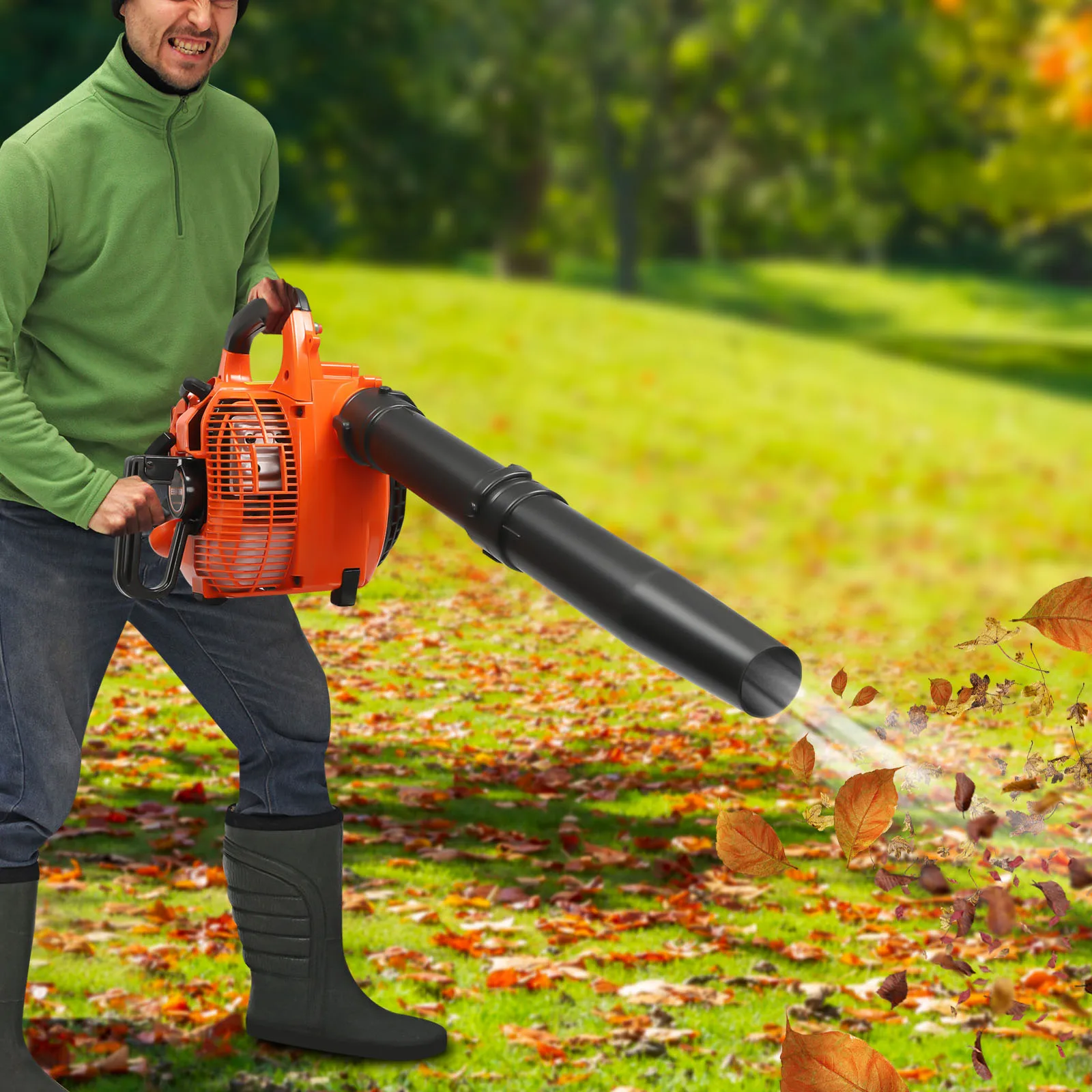
A handheld gas leaf blower generally weighs 8 to 15 pounds when empty. With fuel added, the operating weight may be closer to 9 to 17 pounds, depending on the tank and model.
Gas blowers are often heavier than small electric models because they contain an engine, fuel tank, exhaust system, and vibration-control parts. They may also feel heavier during long use because the user must support the entire machine.
Gas backpack blowers typically weigh 18 to 30 pounds dry. Their straps transfer much of the load to the shoulders and hips. This can make a heavy blower more manageable for large properties, but the machine still creates heat, noise, and physical strain.
Dry weight versus operating weight
“Dry weight” means the blower has no fuel in the tank. It does not represent the weight during normal use.
To estimate the working weight:
Operating weight = dry blower weight + fuel weight + attached accessories
For example, a hypothetical 12-pound gas blower with 1 pound of fuel and a 0.5-pound nozzle weighs about 13.5 pounds while ready to use.
How Heavy Is a Backpack Leaf Blower?
A backpack leaf blower usually weighs 15 to 30 pounds, depending on its engine, battery system, frame, and fuel capacity.
The weight rests on a harness instead of the user’s wrist. This design can improve comfort during long jobs, especially on large lots, farms, parks, and commercial properties. It does not make the blower light. It changes how the load is carried.
A backpack blower may be a better fit when:
- You clear large areas.
- You work for more than a few minutes at a time.
- You need high air volume.
- You want both hands in a more natural position.
- A handheld blower causes wrist or arm fatigue.
A handheld model may still be better for stairs, tight spaces, small yards, and quick cleanup. The best choice depends on total work time, not only the number on the scale.
How Heavy Is a Walk-Behind Leaf Blower?
Walk-behind leaf blowers commonly weigh 80 to 200 pounds or more. Some commercial machines may weigh well above that range.
The wheels carry most of the machine’s weight during operation. You usually push or guide the blower rather than lift it. This makes a walk-behind unit practical for large open areas but difficult to load into a vehicle or carry up steps.
Choose a walk-behind blower only when the work area justifies its size. It may be excessive for a small residential yard. It can be useful for large lawns, long driveways, sports fields, and commercial grounds.

How Much Does a Leaf Blower Weigh With a Battery or Fuel?
The most useful number is the ready-to-use weight. This includes the battery, fuel, tube, and any part attached during normal operation.
Use these simple calculations:
Cordless blower
Total weight = tool-only weight + battery weight + attached nozzle
Example:
- Tool: 6.5 lb
- Battery: 2.8 lb
- Nozzle: 0.4 lb
- Total: 9.7 lb
Gas blower
Total weight = dry weight + fuel weight + attached nozzle
Example:
- Dry blower: 11.5 lb
- Fuel: 1.2 lb
- Nozzle: 0.4 lb
- Total: 13.1 lb
These are hypothetical examples. Check the exact manual or product specification for the model you plan to use.
Why this calculation matters
A difference of 2 or 3 pounds may seem small in a store. It can feel much larger after 20 minutes of repeated sweeping. The effect is greater when you work on slopes, lift the blower often, or use one hand.

Which Leaf Blower Weight Is Best for You?
The right weight depends on the work, your strength, and how long you will hold or move the blower.
| Use case | Practical weight choice |
|---|---|
| Small porch or patio | About 4–7 lb |
| Small yard or driveway | About 5–10 lb |
| Medium residential yard | About 7–14 lb |
| Large property | About 15–30 lb backpack model |
| Large open grounds | Walk-behind model with wheels |
These ranges are starting points, not strict rules. A person who needs long run time may prefer a heavier battery. Someone with limited grip strength may need a lighter handheld model even if it takes longer to finish.
Consider balance, not just pounds
A well-balanced 10-pound blower may feel easier to use than a poorly balanced 7-pound blower. Hold the tool in a store if possible. Check whether:
- The handle fits your hand.
- The trigger is easy to press.
- The nozzle points naturally.
- The battery pulls the tool backward.
- You can switch hands safely.
- The blower does not twist sharply when you start it.
Consider the job surface
Dry leaves on pavement need less force than wet leaves stuck to grass. Heavy debris may require more air volume and a larger blower. A lighter tool may be comfortable but slow if it cannot move the material.
Do not judge performance by weight alone. Compare the manufacturer’s air volume, measured in cubic feet per minute (CFM), and air speed, measured in miles per hour (MPH), under the same test conditions.

Does a Heavier Leaf Blower Work Better?
A heavier leaf blower does not always work better. Weight can indicate a larger motor or battery, but it does not prove stronger airflow.
Performance depends on:
- Air volume
- Air speed
- Nozzle design
- Motor efficiency
- Battery charge
- Fuel condition
- Leaf moisture
- Debris type
- Ground surface
A high-output blower may move leaves faster and shorten the job. That can offset its added weight. On the other hand, a heavy blower with poor balance can cause fatigue without offering a useful advantage.
The practical trade-off is simple: choose enough power for the debris, but avoid carrying more machine than the job needs.
How to Carry and Use a Heavy Leaf Blower Safely
A leaf blower can cause fatigue, hearing damage, eye injuries, and dust exposure if used carelessly. Follow the manual and local rules.
Use these basic precautions:
- Wear safety glasses or sealed eye protection.
- Use hearing protection around gas and high-output blowers.
- Wear sturdy shoes with good traction.
- Keep the nozzle pointed away from people, pets, cars, and windows.
- Check the area for stones, sticks, and other objects before blowing.
- Do not blow dust toward roads, neighbors, open windows, or air intakes.
- Take breaks before your grip or posture fails.
- Use both hands if the manufacturer recommends it.
- Adjust backpack straps so the load rests evenly.
- Turn off the blower before clearing a blockage or changing an attachment.
- Never use a gas blower in an enclosed garage or other closed space.
The U.S. Occupational Safety and Health Administration recommends hearing protection when noise exposure reaches hazardous levels. The exact risk depends on sound level, distance, and exposure time. The owner’s manual may list the blower’s measured noise level.
Local rules also vary. Some U.S. cities and counties restrict gas-powered leaf blowers by season, time of day, noise level, or location. Check your city, county, or homeowners association rules before buying a model.

Common Mistakes When Comparing Leaf Blower Weight
Comparing tool-only weight with ready-to-use weight
A cordless model may look lighter because its listing excludes the battery. Add the exact battery weight before comparing it with another blower.
Treating dry gas weight as operating weight
Fuel adds weight. A dry specification is useful for shipping and comparison, but it is not the full weight during work.
Ignoring the harness or wheels
A backpack blower may weigh more than a handheld model but place less strain on the wrist. A walk-behind blower may be very heavy but require little lifting during use.
Choosing by MPH alone
A high air-speed number does not describe the full performance of a blower. Air volume and nozzle design also matter.
Forgetting storage and transport
A heavy blower may be difficult to lift onto a shelf, carry up stairs, or place in a vehicle. Measure your storage area and consider how you will move the machine when it is not running.

How to Find the Exact Weight of Your Leaf Blower
Use this order when checking a specific model:
- Find the model number on the blower or its packaging.
- Open the manufacturer’s product page or owner’s manual.
- Look for “weight,” “tool weight,” “dry weight,” or “operating weight.”
- Check whether the battery, fuel, tube, and nozzle are included.
- Add the battery or fuel weight when the specification excludes it.
- Confirm the weight of optional attachments.
- Compare the final ready-to-use weight with your expected work time.
The owner’s manual is often more useful than a retailer listing because it explains the included parts and operating setup. Specifications can also change between model versions, so confirm the exact model number.
Frequently Asked Questions
Is a 10-pound leaf blower heavy?
A 10-pound handheld leaf blower is around the middle of the common range. It may feel manageable for short residential jobs but tiring during long use, especially if the weight is poorly balanced or the battery adds several more pounds.
Is a 5-pound leaf blower powerful enough?
A 5-pound blower can work well for dry leaves, grass clippings, patios, decks, and small driveways. It may not move wet leaves, gravel, or large piles as quickly as a heavier high-output model.
Are battery leaf blowers lighter than gas models?
Small battery blowers are often lighter than gas handheld blowers, but the battery must be included in the comparison. A high-output cordless blower with a large battery can weigh as much as, or more than, some gas models.
How much does a leaf blower battery weigh?
Many leaf blower batteries weigh about 2 to 6 pounds. The exact weight depends on the voltage, capacity, and battery design. Check the battery’s own specification rather than estimating from voltage alone.
Can someone with limited strength use a leaf blower?
A light, well-balanced blower may be easier to use, but individual needs differ. Consider the complete operating weight, grip comfort, vibration, trigger force, and how often you must lift the tool. Stop if you feel pain, numbness, dizziness, or unusual shortness of breath, and seek medical advice when needed.
Conclusion
Most residential leaf blowers in the United States weigh 4 to 15 pounds, depending on the power source and design. Cordless and corded handheld models are usually the lightest. Gas handheld blowers weigh more, while backpack and walk-behind models are made for larger areas.
Before choosing a blower, compare the ready-to-use weight, not just the tool-only or dry weight. Add the battery, fuel, tube, and attachments. Then consider balance, run time, airflow, storage, and local noise rules.
For the next step, find the exact model number you are considering and calculate its full operating weight. That number gives you a much better idea of how the blower will feel in your yard.