
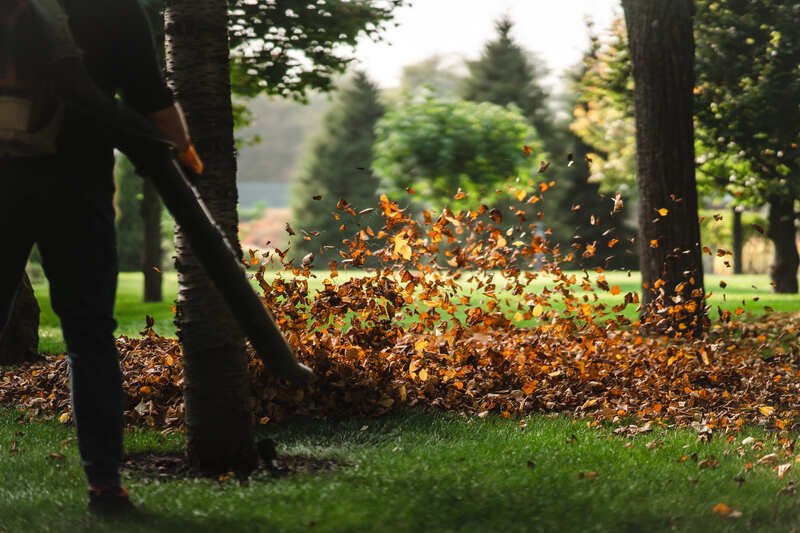
Removing leaves from gravel is easiest when you use low, controlled air instead of full power. Start with dry leaves, set the blower to a low or medium speed, and hold the nozzle several inches above the gravel. Aim at a shallow angle so the air moves the leaves without scattering the stones.
For homes across the United States, the best time to do this is after the leaves dry but before wind or rain packs them into the gravel. Check local noise rules, HOA rules, and fire restrictions before using a gas-powered blower. Wear eye protection, hearing protection, long pants, and closed-toe shoes.

What You Need Before You Start
You need a leaf blower, basic protective gear, and a plan for where the leaves will go. A rake, tarp, leaf bag, or compost bin can make cleanup much easier.
Basic equipment
- Battery, electric, or gas leaf blower
- Safety glasses or other impact-rated eye protection
- Hearing protection, especially with gas blowers
- Work gloves
- Long pants and closed-toe shoes
- Leaf rake for edges and stuck leaves
- Tarp, yard-waste bag, or compost area
- Dust mask if the gravel is very dry and dusty
Read the blower manual before use. The manual gives the correct starting method, battery instructions, extension-cord limits, and safety warnings for that model.
Choose the right blower
Most blowers can move leaves from gravel, but control matters more than maximum power.
| Blower type | Main benefit | Main drawback |
|---|---|---|
| Battery | Quiet, easy to start, and easy to control | Limited run time and charging needs |
| Electric corded | Steady power for small areas | The cord can restrict movement |
| Gas | Strong airflow and long work time | More noise, fuel, fumes, and maintenance |
A high-powered blower is not always better. Too much air can move small stones, dust, mulch, and loose soil along with the leaves.
Before blowing, remove sticks, toys, wires, and other objects from the work area. A blower can turn small objects into projectiles.

Prepare the Gravel Area
Preparation prevents leaves from becoming trapped and helps keep gravel in place. Walk around the area and identify its edges, nearby doors, parked cars, windows, drains, and planting beds.
Check the weather
Dry leaves are much easier to move than wet leaves. If the leaves are damp:
- Wait for a dry period if possible.
- Spread thick piles with a rake.
- Let the leaves dry for a few hours.
- Blow them when they become light and loose.
Wet leaves often stick to gravel. Blowing them at high speed may only push them into a heavier mat.
Wind direction also matters. Work with the wind when you can. Blowing into a strong headwind wastes power and can send leaves back over the area you just cleared.
Set a collection point
Choose the final location before you turn on the blower. Good options include:
- A tarp at the edge of the driveway
- A compost pile
- A yard-waste container
- A paper lawn bag
- A designated municipal leaf-collection area
Do not push leaves into a public street, sidewalk, storm drain, or neighboring property. In many U.S. communities, leaves in streets can block drains or create hazards for traffic and pedestrians. Local rules may also prohibit placing yard waste near stormwater inlets.
Protect delicate surfaces
Close nearby windows and doors. Move vehicles away from the work zone. If the gravel borders siding, screens, outdoor furniture, or painted surfaces, use a lower speed near those items.
A strip of cardboard, landscape edging, or a folded tarp can help keep gravel from entering flower beds or lawns while you work.

Step-by-Step: How to Remove Leaves From Gravel With a Leaf Blower
Use short passes and moderate airflow. The goal is to make the leaves slide or roll across the gravel, not to blast them into the air.
1. Start at the highest or farthest point
Begin at the farthest edge of the gravel area. Work toward your collection point or toward the lower side of a slope.
This prevents you from walking across areas that you have already cleared. It also gives leaves fewer places to hide behind your feet or equipment.
2. Set the blower to a low or medium speed
Start with the lowest setting that moves the leaves. Increase the speed only if the leaves do not move.
A lower setting helps you:
- Keep gravel in place
- Reduce dust
- Protect nearby plants
- Avoid scattering leaves into new areas
- Improve control around walls and vehicles
If the blower has adjustable speed, use the trigger or dial instead of running it at full power.
3. Hold the nozzle several inches above the gravel
Keep the nozzle roughly 6 to 12 inches above the surface as a starting point. The exact distance depends on the blower, gravel size, leaf weight, and surface shape.
Do not press the nozzle close to the stones. A close blast can lift gravel and create dust. If stones begin to move, raise the nozzle, lower the speed, or change the angle.
4. Aim at a shallow angle
Point the nozzle slightly across the gravel rather than straight down. A shallow angle lets air pass over the stones and push the leaves along the surface.
Use a sweeping motion from side to side. Think of guiding the leaves like a slow wave. Do not make sudden movements that scatter them in every direction.
5. Create small windrows
Move the leaves into narrow rows instead of trying to blow the whole area into one large pile. A windrow is a long, shallow line of leaves.
Small windrows are easier to control. Once one row is formed, move it toward the tarp or collection point with several short passes.
6. Work around edges by hand
Leaves often collect where gravel meets:
- Lawn
- Landscape fabric
- Curbing
- A garage door
- A wall
- Shrubs
- Fence posts
Lower the blower speed near these edges. Use a rake or gloved hand for leaves trapped beneath plants or between larger stones.
7. Finish with a slow inspection pass
After the main cleanup, walk the area and look for leaves under shrubs, along borders, and in low spots. Use a low blower setting for the final pass.
A slow finish usually works better than another high-power blast. It removes the last leaves while reducing the chance of moving the gravel.

How to Keep Gravel From Blowing Away
The safest approach is to control air speed, nozzle height, and direction. Gravel moves when the air force exceeds the weight and friction holding the stones in place.
Several factors change how easily gravel moves:
- Stone size
- Stone shape
- Gravel depth
- Surface slope
- Soil moisture
- Blower power
- Nozzle distance
- Wind speed
Small, dry, rounded stones usually move more easily than larger, angular stones. Loose gravel on a steep slope may shift even at a moderate blower setting.
Use this adjustment order
If gravel starts moving, make changes in this order:
- Lower the blower speed.
- Raise the nozzle.
- Point the nozzle more horizontally.
- Work from a different direction.
- Use a rake for the area that remains difficult.
Do not solve the problem by standing closer and using more power. That usually increases stone movement and dust.
Test a small area first
Before clearing the full driveway, path, or garden border, test a section about 2 to 3 feet wide. Watch the gravel for several seconds.
The setting is suitable when:
- Leaves move in the intended direction.
- Gravel stays mostly in place.
- Dust remains limited.
- Plants and nearby surfaces are not damaged.
If the test fails, adjust the blower before continuing.

How to Remove Wet Leaves and Packed Leaf Mats
Wet leaves need a different method because they are heavier and often stick to the gravel. A blower may not remove them cleanly in one pass.
Start by breaking up the mat with a leaf rake. Use light strokes so the rake does not pull gravel into the pile. Then wait for the leaves to dry if weather allows.
For stubborn areas:
- Loosen the leaf mat with a rake.
- Separate large clumps by hand while wearing gloves.
- Blow the loose leaves at low or medium speed.
- Collect the leaves before they spread again.
- Repeat in small sections.
Avoid using a blower at full power on a wet, compacted pile. The air may lift dust and debris around the edges while leaving the heavy center in place.
If leaves have mixed with mud, seed pods, or fine soil, a rake may work better than a blower. In some cases, removing the top layer by hand is the cleanest way to protect the gravel surface.

How to Clean Gravel Without Making a Dust Cloud
Dust is common when gravel is dry, especially on driveways and paths with fine material between the stones. Dust can reduce visibility and irritate the eyes, nose, and lungs.
To limit dust:
- Use the lowest effective blower setting.
- Keep the nozzle farther from the surface.
- Blow across the gravel, not directly into it.
- Work when the air is calm.
- Avoid blowing very dry material near open windows.
- Wear eye protection.
- Use a suitable dust mask if conditions remain dusty.
Do not soak the gravel just to stop dust unless the surface and local drainage conditions allow it. Excess water can create muddy patches, wash fines into drains, and make leaves harder to collect.
Stop work if visibility becomes poor or dust moves toward people, pets, roads, or neighboring homes.

Best Technique for Driveways, Paths, and Garden Beds
The surface around the gravel changes the best method.
Gravel driveways
Start near the garage or house and work toward the street-side edge, unless wind or drainage makes another direction safer. Keep leaves away from the garage door seal and drainage channels.
Do not blow leaves into the street. Move them to a tarp, yard-waste bin, or approved collection area instead.
Gravel walkways
Clear one side first so people can still pass safely. Keep the blower pointed away from doors, windows, and pedestrians.
If the path is narrow, a rake may provide better control than a powerful blower. Use the blower for the final light leaves.
Decorative gravel beds
Use extra care around plants, landscape fabric, edging, and decorative stones. Blow parallel to the border rather than directly toward it.
A handheld rake or small battery blower may work better than a large gas blower in a garden bed. The lower airflow is easier to control around plants.
Gravel around vehicles
Move vehicles before cleaning when possible. Air can send grit against paint, windows, or trim. Keep the nozzle pointed away from the vehicle and use low power near tires and doors.

Common Mistakes to Avoid
The most common mistake is using maximum power from the start. High airflow may move leaves quickly, but it can also scatter them, shift gravel, and create dust.
Avoid these errors:
- Blowing wet leaves without loosening them first
- Pointing the nozzle straight down
- Holding the nozzle too close to the gravel
- Starting without a collection plan
- Blowing leaves into streets or drains
- Working toward people, pets, cars, or windows
- Ignoring wind direction
- Using a gas blower in a closed garage
- Leaving a cord where it can be cut or tripped over
- Clearing dry leaves near an open flame or active fire area
- Blowing stones into lawn equipment, siding, or vehicles
Never use a gas-powered blower inside a garage, shed, or other enclosed space. Engine exhaust contains carbon monoxide, which can build up quickly in enclosed areas.
Follow the blower maker’s instructions for battery charging and cord use. Stop the machine before clearing a jam or removing debris from the intake.

What to Do If the Leaves Will Not Move
If the blower does not remove the leaves, check the cause before increasing power.
| Problem | Likely cause | Better response |
|---|---|---|
| Leaves barely move | Leaves are wet or packed | Loosen them with a rake and let them dry |
| Leaves scatter everywhere | Air speed is too high | Lower the speed and use a shallow angle |
| Gravel moves with the leaves | Nozzle is too close or powerful | Raise the nozzle and reduce airflow |
| Dust blocks your view | Surface is very dry | Lower speed, increase distance, and stop if visibility drops |
| Leaves return after clearing | Wind is blowing against you | Change direction or wait for calmer air |
| Leaves stay at the border | They are trapped in plants or edging | Use a rake or remove them by hand |
| Blower loses power | Low battery, blocked intake, or fuel issue | Stop safely and follow the manual |
The best fix is usually better control, not more force. If the area remains difficult, divide it into smaller sections and use a rake for the heavy or trapped leaves.

Key Takeaways
- Use dry leaves whenever possible.
- Start with low or medium blower power.
- Hold the nozzle about 6 to 12 inches above the gravel.
- Aim across the surface at a shallow angle.
- Work in small sections toward a tarp or approved collection point.
- Lower the speed near plants, walls, cars, and borders.
- Rake wet or packed leaves before blowing.
- Stop if gravel moves, dust becomes heavy, or visibility drops.
- Keep leaves out of streets, sidewalks, and storm drains.
- Follow the blower manual and local U.S. noise and yard-waste rules.
Frequently Asked Questions
Can a leaf blower remove leaves from pea gravel?
Yes, but pea gravel moves more easily than larger, angular stone. Use low airflow, keep the nozzle higher, and test a small area first. A rake may be better for leaves trapped deep in the gravel.
Should I use a leaf blower on wet gravel?
You can, but wet leaves are harder to move and may stick to the stones. Let the leaves dry when possible. If you must clean them while wet, loosen them with a rake and use short, controlled blower passes.
What blower speed is best for gravel?
Use the lowest setting that moves the leaves. There is no single correct speed because blower power, gravel size, leaf moisture, and wind all differ. If the stones move, reduce speed or raise the nozzle.
Is it better to blow leaves before or after rain?
It is usually easier to blow leaves before rain or after the leaves have dried. Rain makes leaves heavy and can press them into the gravel. A short dry period can make a large difference.
Can I blow leaves into my yard?
You can move leaves onto your own lawn if the leaves will not damage plants or block drainage. However, collect thick piles if they could smother grass. Compost them or follow your local yard-waste collection rules.
Conclusion
To remove leaves from gravel with a leaf blower, use low power, keep the nozzle above the surface, and aim across the stones rather than straight down. Work with the wind, clear small sections, and collect the leaves at a planned location.
When leaves are wet or packed, loosen them with a rake first. If gravel begins to move or dust becomes heavy, stop and adjust the speed, height, or direction. A controlled pass may take slightly longer, but it protects the gravel and leaves the area cleaner.
1 thought on “How To Remove Leaves From Gravel With A Leaf Blower: Easy Tips”