
If your cordless leaf blower battery dies fast, the usual causes are high power use, a battery that is too small or too old, cold weather, blocked airflow, or a charging problem. In the United States, most battery leaf blowers use lithium-ion packs. These packs can lose runtime when you use turbo mode, clear wet leaves, work in very cold weather, or store the battery in a hot garage.
Start by checking three things:
- The battery charge level and age
- The blower’s power setting and airflow path
- The charger, contacts, and storage conditions
A battery that shuts off at once may have a protection fault. A battery that slowly loses power may simply be under heavy load or near the end of its service life.
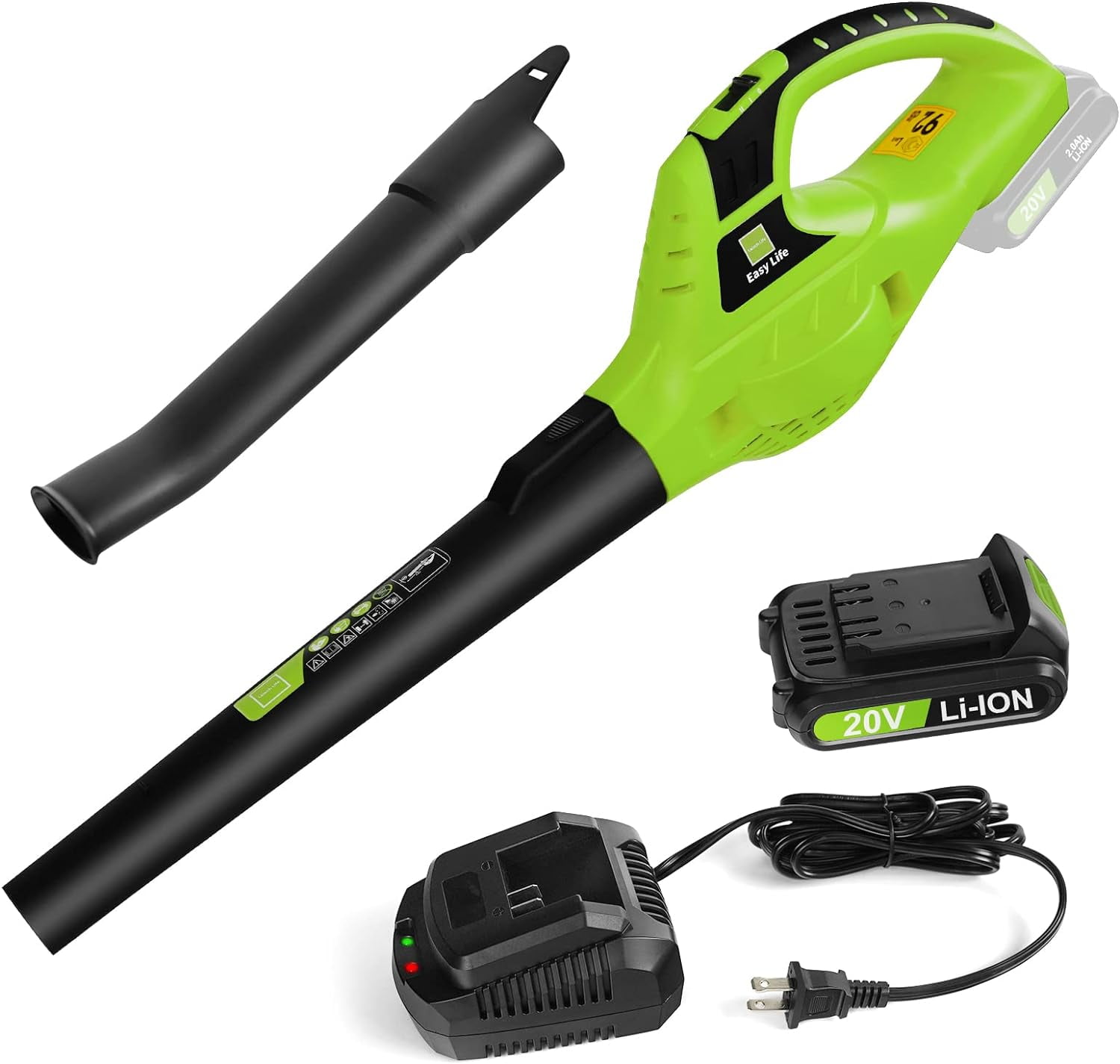
The Most Common Reasons a Leaf Blower Battery Dies Quickly
A battery leaf blower can lose power quickly for several different reasons. The most likely cause depends on how fast the battery drains and how the blower behaves before it stops.
1. Turbo mode uses much more power
Turbo or boost mode gives the blower more air speed and air volume. It also draws more current from the battery.
Many users hold the turbo button for the whole job. That can cut runtime sharply. Use the lower setting for dry leaves on pavement, decks, and driveways. Save turbo mode for wet leaves, heavy piles, grass, or packed debris.
2. The battery has a low amp-hour rating
Amp-hours, shown as Ah, describe how much energy a battery can store. A 2.0 Ah battery usually runs for less time than a 5.0 Ah battery on the same blower.
The Ah number is not a promise of exact runtime. Power demand changes with the blower setting, air resistance, temperature, and debris. Still, it is a useful guide when comparing batteries in the same product system.
3. The leaves are wet or heavy
Wet leaves need more force to move. The blower motor must work harder, so it draws more energy.
A blower may run for a long time when moving dry leaves across a hard surface. The same blower may drain its battery much faster when pushing wet leaves through grass or thick mulch.
4. The air tube or intake is blocked
Grass, leaves, string, and dirt can reduce airflow. A blocked tube makes the motor work harder and may cause the battery or motor to heat up.
Before cleaning the blower, remove the battery. Check the nozzle, tube, intake screen, and fan area. Do not reach into the fan with your hand.
5. The battery is cold or very hot
Lithium-ion batteries often provide less power in cold weather. A cold pack may show a charge but lose voltage under load. The blower may then shut off early.
High heat can also reduce performance and speed battery wear. Do not leave the battery in a hot vehicle or in direct sun. Follow the temperature limits in the owner’s manual.
6. The battery is aging
Rechargeable batteries lose capacity over time. A pack may still charge to “full” while holding much less energy than it did when new.
Age, charge cycles, storage heat, deep discharge, and heavy loads all affect battery life. If a fully charged battery runs for only a few minutes in normal conditions, wear is a likely cause.
7. The charger or battery contacts are dirty
Dust or corrosion on the contacts can prevent a full charge. The charger may show a normal light even though the battery is not charging correctly.
Inspect the contacts for dirt, moisture, or damage. Keep the contacts dry. Do not scrape them with a metal tool or spray cleaner into the battery.
8. The battery is not compatible with the blower
Battery systems are not universal. A pack may fit physically but still be wrong for the tool, voltage class, or communication system.
Use only batteries and chargers approved for your blower. Do not use a damaged pack, a modified pack, or a third-party battery unless the manufacturer clearly lists it as compatible.
How to Tell Whether the Battery or Blower Is the Problem
The quickest test is to use a known-good battery from the same approved system. If the blower runs normally with that battery, the original pack is the main suspect. If both batteries drain quickly, inspect the blower, airflow, and work conditions.
Use this symptom guide:
| Symptom | Likely cause | Best first check |
|---|---|---|
| Runs only a few minutes on every setting | Worn battery or charging fault | Test with another approved battery |
| Runs well on low but dies fast on turbo | High power demand | Use a lower setting and check the Ah rating |
| Stops suddenly, then works again later | Heat or battery protection shutdown | Let the tool and pack cool |
| Loses power in cold weather | Cold battery performance | Warm the battery indoors before use |
| Motor sounds strained | Blocked tube, dirty intake, or heavy debris | Remove the battery and clear the airflow path |
| Charger finishes unusually fast | Battery may not be accepting a full charge | Clean contacts and check the charger |
| Battery becomes very hot, swells, or smells odd | Possible battery failure | Stop using it and follow battery disposal guidance |
A simple comparison test
Perform this test only when the battery and tool show no damage:
- Fully charge the battery with the correct charger.
- Let the battery reach room temperature.
- Clean the blower tube and intake.
- Run the blower on its lowest useful setting.
- Repeat with a second approved battery, if available.
- Compare the runtime and blower behavior.
Use similar conditions for both tests. Do not compare a dry driveway test with a wet lawn test. Do not run the blower until the battery is completely empty. Stop if the battery or tool becomes unusually hot.
If one battery performs well and the other does not, replace or service the weak battery. If both perform poorly, the blower may have an airflow, motor, or electronic fault.
How to Estimate Normal Leaf Blower Runtime
You can estimate runtime with a simple energy calculation, but the result is only a starting point.
A battery’s approximate energy is:
Voltage × amp-hours = watt-hours
For example, a hypothetical 40-volt, 2.5 Ah battery has about:
40 × 2.5 = 100 watt-hours
If a blower uses about 500 watts during a certain test condition, the simple estimate is:
100 watt-hours ÷ 500 watts = 0.2 hours, or about 12 minutes
Real runtime may be lower. The battery may not deliver all its stored energy under heavy load. Motor efficiency, battery temperature, turbo use, and the manufacturer’s voltage method also affect the result.
Why two blowers with the same battery can have different runtime
Runtime depends on more than voltage and Ah. Important factors include:
- Motor design
- Fan size and speed
- Air speed and air volume
- Battery condition
- Turbo use
- Debris type
- Nozzle design
- Outdoor temperature
- Airflow restrictions
Treat advertised runtime as a test result under stated conditions, not a guarantee for every yard.
A practical runtime example
Suppose a 5.0 Ah battery lasts:
- 45 minutes on low power
- 25 minutes on medium power
- 12 minutes on turbo
That pattern may be normal. Turbo mode can demand several times more power than low speed. The battery is not necessarily defective just because the turbo runtime is short.
Troubleshooting Steps: What to Do Before Buying a New Battery
Follow these checks in order. They begin with simple causes and move toward replacement or repair.
Step 1: Check the battery indicator
Charge the pack with the correct charger. Look for an error light, unusual charging time, or a battery that becomes hot while charging.
Some battery systems use a fuel gauge on the pack. The gauge can be helpful, but it does not measure exact remaining runtime. A battery may show several bars and still drop quickly under a high load.
Step 2: Bring the battery to room temperature
If the battery was stored in a cold shed or hot vehicle, let it return to room temperature before charging or testing it. Do not heat a cold battery with a heater, hair dryer, oven, or direct flame.
If the pack is hot after use, let it cool in a dry, shaded area. Follow the temperature limits in the manual.
Step 3: Inspect and clean the blower
Remove the battery before inspection. Check:
- Intake screens
- Air tubes
- Nozzles
- Fan housing
- Grass and string near the motor
- Dirt around the battery connection
Use a soft brush or dry cloth. Do not spray water into the motor or battery compartment unless the manual specifically permits it.
Step 4: Clean the battery and charger contacts
Disconnect the charger. Make sure the contacts are dry and free of dirt. If the contacts are damaged, bent, burned, or corroded, stop using the equipment until it is inspected.
Never bridge battery contacts with metal objects. A short circuit can cause burns, fire, or battery damage.
Step 5: Test different power levels
Run the blower on low, medium, and turbo. If low power gives reasonable runtime but turbo drains the pack quickly, the battery may be working normally.
If the blower loses power even on low, continue with a second battery test.
Step 6: Test an approved battery of the same system
A second battery is the most useful comparison. Use the same Ah class when possible.
- Only one battery fails: The battery or its charger may be faulty.
- All batteries fail: The blower may need service.
- Both work but runtime is short: The work conditions or battery size may not match the job.
Step 7: Check the warranty and service path
Battery warranties vary by brand, product line, and region. Keep the receipt, model number, serial number, and purchase date. Check the manufacturer’s United States support page or owner’s manual for the correct process.
Do not open a lithium-ion battery pack. Internal cells can retain dangerous energy even when the pack appears empty.
How to Make a Leaf Blower Battery Last Longer
You can improve both daily runtime and long-term battery health by changing how you use and store the blower.
Use the lowest setting that gets the job done
Start on low or medium. Increase power only when needed. This often gives more control and reduces the amount of dust and debris you move.
For dry leaves on pavement, a lower setting may be enough. For wet leaves in grass, short bursts of turbo may work better than holding turbo continuously.
Work with the wind, not against it
Wind direction affects how much work the blower must do. Move debris in stages toward a collection area. Avoid pushing a large pile across thick grass when you can clear a path first.
This reduces load on the fan and may extend runtime.
Keep the air path clear
Inspect the blower before each job. A clean intake and nozzle help the motor move air without unnecessary resistance.
Do not modify the tube or remove safety parts to increase airflow. A change that seems to improve air speed may also damage the motor or create a safety risk.
Store the battery correctly
Use the storage method listed in the manual. In general:
- Keep the battery dry.
- Avoid extreme heat and cold.
- Keep it away from metal objects.
- Do not store a damaged or swollen pack.
- Do not leave the pack on the charger indefinitely unless the manufacturer allows it.
- Store it where children cannot access it.
For long-term storage, follow the manufacturer’s recommended charge level. Different brands may give different instructions.
Use the correct charger
A charger made for another battery system may damage the pack or create a fire hazard. Even chargers with the same connector may use different charging controls.
Use the charger listed for the battery model or approved battery family.
When a Leaf Blower Battery Should Be Replaced
Replace the battery when it has clearly lost capacity, fails a comparison test, or shows physical damage. A battery may be ready for replacement when:
- Runtime is much shorter than it was under the same conditions.
- The pack will not charge fully.
- The charger repeatedly reports an error.
- The battery shuts off under light loads.
- The casing is cracked, swollen, leaking, or unusually hot.
- The contacts are burned or damaged.
Do not throw a lithium-ion battery in household trash or a curbside recycling bin unless your local program specifically accepts it. In the United States, the U.S. Environmental Protection Agency advises consumers to use proper battery recycling and disposal options. Call2Recycle also provides a United States drop-off locator at Call2Recycle.org.
If a battery is swollen, smoking, leaking, or producing a strong odor, move away from it. Do not charge or use it. Contact the manufacturer, local fire department, or local hazardous-waste authority for guidance.
Battery Size: Which Amp-Hour Rating Do You Need?
A larger battery can provide longer runtime, but it also adds weight and cost. The right size depends on the length of the job and the blower system.
| Battery size | Typical fit | Main trade-off |
|---|---|---|
| 2.0 Ah | Short cleanup jobs | Light, but limited runtime |
| 4.0 Ah | Small to medium yards | Balanced weight and runtime |
| 5.0–6.0 Ah | Larger areas or longer work | Longer runtime, more weight |
| Higher capacity | Extended work with fewer stops | Heavier and often more expensive |
These are general categories, not guaranteed runtimes. A 2.0 Ah pack may be enough for a porch and driveway. A larger pack may make more sense for a large property, wet leaves, or repeated cleanup.
If the blower feels heavy before the job starts, two smaller batteries may be easier to handle than one very large pack. The best choice is the one that matches the work without causing hand, arm, or shoulder strain.
Safety Rules for Lithium-Ion Leaf Blower Batteries
Battery tools are convenient, but damaged lithium-ion packs can create serious hazards. Follow the safety rules in the tool and battery manuals.
Stop using the battery if it is:
- Swollen
- Cracked
- Leaking
- Smoking
- Punctured
- Very hot without a clear reason
- Producing an unusual smell
- Making a hissing or popping sound
Do not open, crush, drill, drop, modify, or repair the pack yourself. Do not place a battery in water. Keep loose batteries away from keys, coins, nails, and other metal items.
The U.S. Consumer Product Safety Commission and local fire authorities provide safety information for lithium-ion products. For a damaged battery, use the manufacturer’s emergency guidance and local hazardous-waste instructions.
Also wear eye protection when blowing leaves. Dust, gravel, and small sticks can travel at high speed. Keep people, pets, and open windows away from the discharge path.
Why Does My Leaf Blower Battery Die Fast Even After Charging?
A battery can reach a full-charge indicator while having reduced usable capacity. This happens when the cells have aged or when the charger and battery are not making a proper connection.
Clean and inspect the contacts, then test the battery with the correct charger. If the pack still charges quickly and runs for only a short time, its capacity may have fallen. A second approved battery can confirm the problem.
Why Does My Leaf Blower Stop and Start?
Stop-and-start operation often points to overheating, a blocked airflow path, a loose battery connection, or electronic protection. Let the tool cool. Remove the battery and check the tube and intake.
If the problem continues on a clean blower with a known-good battery, stop using the tool and contact the manufacturer or an authorized service center.
Is It Bad to Run a Leaf Blower Battery Until It Is Empty?
Repeated deep discharge can add stress to a rechargeable battery. You do not need to run the pack completely empty before charging it.
Recharge and store the battery as the manufacturer directs. Do not force the tool to keep running after it begins to shut down or loses power.
Can I Use a Higher-Amp-Hour Battery?
You may use a higher-Ah battery only if the manufacturer lists it as compatible with the blower. A higher Ah rating within the same approved battery system often means more stored energy, but it also adds weight.
Do not use a battery just because it has the same voltage or appears to fit. Compatibility includes the battery electronics, charger, tool design, and manufacturer approval.
How Long Should a Leaf Blower Battery Last?
There are two meanings of “last.” A single charge may last from several minutes to close to an hour, depending on the battery, blower setting, and workload. The battery pack itself may last for years, but its capacity gradually declines with use, heat, and age.
The most useful comparison is your own past runtime under similar conditions. If runtime drops sharply, test the pack with another battery and inspect the blower before buying a replacement.
Conclusion
A leaf blower battery usually dies fast because the blower is using high power, the work is unusually demanding, or the battery has lost capacity. Turbo mode, wet leaves, blocked airflow, extreme temperatures, and small battery packs are common explanations.
Charge the pack correctly, let it reach room temperature, clean the blower, test lower power settings, and compare it with another approved battery. Replace a pack only after these checks, unless it is swollen, damaged, leaking, or dangerously hot. In that case, stop using it and follow safe battery disposal guidance.